


The concept of home entertainment has evolved from a simple television stand to a sophisticated architectural focal point. Achieving the Perfect Media Wall Design requires more than just mounting a screen; it involves a meticulous blend of aesthetics, utility, and technical precision. Whether you are looking for a sleek minimalist look or a grand feature wall with integrated fireplaces, the right design choices will define your living space for years to come.
Understanding the spatial dynamics of your room is the first step. A media wall serves as the heart of the modern home, acting as a bridge between high-end technology and interior styling. By focusing on layout and proportion, you can ensure that your entertainment hub does not overwhelm the room but rather enhances its existing character.
Before picking materials, you must determine the primary function of your installation. Will it purely be for viewing, or do you need integrated storage? The perfect media wall design starts with a clear blueprint of how the components interact. This includes the television, soundbar, shelving units, and often an electric fire.
Symmetry plays a vital role in visual comfort. Many homeowners opt for a centered TV placement with balanced shelving on either side. However, asymmetrical designs are gaining popularity for those seeking a contemporary edge. Regardless of your style preference, the goal is to create a cohesive look that guides the eye naturally toward the screen.
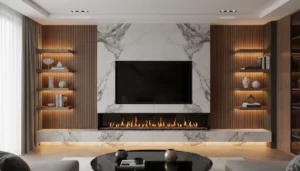
One of the most common mistakes in media wall construction is incorrect TV placement. To achieve a perfect media wall design, the screen must be at eye level when seated. This usually means the center of the TV should be approximately 105 cm to 115 cm from the floor, depending on the height of your sofa.
Calculating the distance between your seating and the wall is equally important. For a 4K resolution screen, a common rule of thumb is to sit at a distance roughly 1.5 times the vertical screen size. This ensures you capture every detail without straining your eyes or seeing individual pixels.
(For deeper insights into this, read our comprehensive guide on [Optimizing Room Ergonomics for Home Cinemas].)
The materials you choose will dictate the longevity and “feel” of the installation. High-Quality MDF is often used for its versatility and smooth finish, allowing for seamless painting. However, incorporating natural textures like wood slats or stone veneers can add a layer of luxury to the perfect media wall design.
Veneered Oak: Adds warmth and a premium organic touch.
Venetian Plaster: Provides a high-end, textured concrete look.
Acoustic Panels: Improves sound quality while adding vertical visual interest.
Using contrasting materials can help define different zones within the wall. For instance, a dark matte finish behind the TV reduces glare, while lighter wooden accents on the shelving create a welcoming atmosphere.
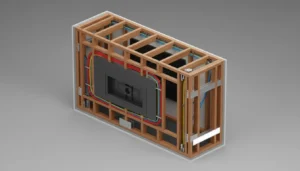
A media wall is only as good as its hidden infrastructure. You must account for cable management and ventilation early in the process. Overheating is a silent killer for high-end electronics, so ensuring adequate airflow behind the TV and inside equipment cabinets is essential for a perfect media wall design.
| Component | Recommended Clearance | Technician’s Pro-Advice |
| LED TV | 5 cm on all sides | Ensure the recessed “niche” is 2 cm deeper than the TV to allow for slim-line tilting brackets. |
| Soundbar | 10 cm below TV | Avoid placing soundbars deep inside a shelf; keeping them flush with the front edge prevents “muffled” audio reflections. |
| Electric Fire | 20 cm to 30 cm below TV | Check the heat discharge location; front-venting models are mandatory for recessed installations to protect the TV. |
| Game Consoles | 15 cm height clearance | Install silent 120 mm USB fans in the cabinetry to exhaust hot air generated by high-performance GPUs. |
Lighting is the secret ingredient that transforms a static structure into a dynamic feature. To achieve the perfect media wall design, you should use a layered lighting approach. Ambient light provides general illumination, while task lighting highlights specific décor items on shelves.
LED strips are the industry standard for media walls. Specifically, COB (Chip on Board) LED strips are preferred because they provide a continuous “dot-less” glow. Integrating these into the “niche” behind the TV can create a halo effect that reduces eye strain during nighttime viewing.
(Discover more about integrated light controls in our latest article: [Smart Home Lighting Integration Tips].)
Clutter is the enemy of a high-impact media wall. Incorporating “push-to-open” cabinets allows for a handle-less, sleek appearance that complements a perfect media wall design. These cabinets can hide bulky items like subwoofers, satellite boxes, and gaming controllers.
If you prefer an open-shelf look, use the “Rule of Three” when styling. Grouping items in threes with varying heights creates a balanced aesthetic. Remember, the TV should remain the star of the show; over-accessorizing the surrounding shelves can distract from the viewing experience.
Sound behaves differently when it is enclosed. If you are building a cavity for your speakers, you are essentially building a speaker cabinet. For the perfect media wall design, consider lining the speaker recesses with acoustic foam to prevent unwanted vibrations and bass “boominess.”
Subwoofers require special attention. Since they produce low-frequency vibrations, they should ideally be placed on the floor or within a reinforced compartment. If the subwoofer is vibrating the entire wall structure, it will distort the audio and potentially loosen the mounting hardware of other components.
| Feature | Best Practice | Technician’s Pro-Advice |
| Cable Access | Use 50 mm brush plates | Always run two spare HDMI 2.1 cables during construction; replacing cables inside a finished wall is nearly impossible. |
| Power Supply | Minimum 6 outlets | Install a dedicated surge protector inside the wall to safeguard your entire setup from voltage spikes. |
| Frame Strength | Use C16 timber studs | Reinforce the TV mounting area with 18 mm plywood behind the plasterboard to support heavy large-format screens. |
Technology moves faster than interior design trends. A perfect media wall design should be adaptable. Instead of building a niche that perfectly fits your current 55-inch TV, consider making it slightly larger to accommodate a future upgrade to a 65-inch or 75-inch model.
Using modular components or removable panels can also be a lifesaver. If a cable fails or you decide to add a new gaming system, having an accessible “chase” or conduit system ensures you won’t have to tear down the plasterwork.
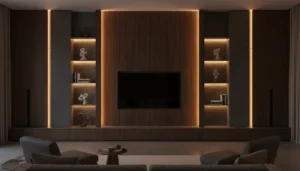
The ideal height is eye level while seated, which usually places the center of the screen 105 cm to 115 cm from the floor. This ergonomic placement prevents neck strain and ensures the best color accuracy from the panel. A perfect media wall design prioritizes the viewer’s comfort over high-wall aesthetics.
Yes, you can place a soundbar in a dedicated niche, but it must be flush with the front of the wall. Placing it too deep causes sound waves to bounce off the shelf edges, creating audio distortion. For a perfect media wall design, ensure the soundbar has enough clearance for top-firing “Atmos” speakers if applicable.
Absolutely, as modern televisions generate significant heat from their back panels and internal processors. A perfect media wall design incorporates a gap of at least 5 cm around the TV and utilizes “chimney effect” venting or internal fans to ensure cool air circulates, preventing hardware failure and screen discoloration.
Most professionals use timber stud work finished with plasterboard or MDF for the main structure. For the perfect media wall design, using fire-rated boards is crucial if you are integrating an electric fireplace. Adding acoustic slat wood panels can also improve the room’s sound profile while providing a high-end, modern finish.
Creating a bespoke entertainment hub is a significant investment that adds both value and character to your home. By focusing on the perfect media wall design, you balance the technical requirements of modern electronics with the timeless beauty of well-crafted cabinetry. From the initial framing and ventilation to the final touches of ambient lighting and décor, every detail contributes to a superior cinematic experience. Plan for the future, prioritize ergonomics, and enjoy a living space that truly makes an impact.


